
Apr 02, 2025
Dangba Lithium Mine Has Exceeded One Million Tons, Becoming The Largest Deposit Of Its Kind In Asia!
Recently, the Dangba Lithium Mine in Malkang City, Aba Prefecture, Sichuan Province, has passed the mineral resource reserve review and filing by the Ministry of Natural Resources. It has added 440000 tons of lithium oxide resources and identified a total of 1.1207 million tons of lithium oxide resources, becoming the first granite pegmatite lithium deposit in Sichuan Province with lithium oxide resources exceeding one million tons. It is also the largest granite pegmatite lithium deposit in Asia with proven resources to date.
It is reported that the Dangba mining area is located in the Keryin area of Aba Prefecture. In 2007, the identified lithium oxide resources in the Dangba mining area were less than 10000 tons. Not far from the Dangba mining area, the exploration of the Lijiagou spodumene deposit, also located in the Keryin area, was also progressing poorly at that time. However, a few years later, the Sichuan Comprehensive Geological Survey and Research Institute, a subsidiary of the Sichuan Geological Survey and Research Institute, opened the door to lithium resources and made a major breakthrough in Lijiagou, discovering super large scale deposits.
In 2011, the Sichuan Provincial Institute of Comprehensive Geological Survey included the mining and exploration rights of the Dangba mining area in the overall survey. Tang Wenchun, Chief Scientist of Sichuan Geological Survey and Research Institute, said, "Both the Lijiagou and Dangba deposits face challenges such as thick surface soil cover, relatively few exposed ore bodies, and difficult to grasp distribution patterns. However, each deposit is different, for example, the lithium mines in Lijiagou cluster in a 'parallel' shape, while the Dangba ore bodies cluster like a 'goose formation'. This also means that the successful experience of Lijiagou cannot be directly replicated in the Dangba mining area

Geological team members are conducting field surveys. Map provided by Sichuan Geological Survey and Research Institute
Through the comprehensive application and collaborative combination of multiple professional methods such as geophysics, geochemistry, and remote sensing, the exploration team has conducted in-depth research on the mineralization conditions and enrichment laws of the mining area. After identifying the hidden parts of thick and large ore bodies, geological engineering such as drilling has been used to verify and control the ore bodies. Through in-depth research on more than 10 subjects, the hidden mineral morphology and spatial location of the Dangba deposit gradually became clear. From the slope map of the mining area, the mineral veins we are looking for are like a 'fine ribbon', irregularly extending from the surface to the deep crust. After discovering the traces of the mineral veins, we proceeded to drill holes, "said Cai Yunhua, the field manager and senior geological engineer.
It is reported that the entire work area has a height difference of 2200 meters, and technicians have set up more than 140 boreholes in it, with a total footage of over 40000 meters. Finally, 11 lithium ore bodies were identified, with one main ore body accounting for over 80% of the total resources. Cai Yunhua explained that in the third stage of the exploration work, the exploration team innovatively applied advanced technology of hydraulic portable drilling machines to implement green exploration technology of one base porous and one hole multi support, solving the technical problem of large deviation from the ore body due to deep deformation and displacement of drilling holes, and greatly improving exploration efficiency.
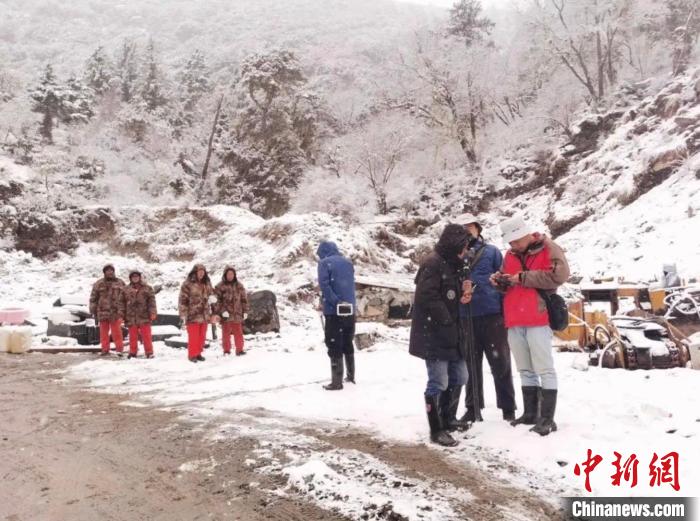
Geological team members are conducting field surveys. Map provided by Sichuan Geological Survey and Research Institute
It is reported that since 2011, more than 170 million yuan has been invested in the exploration of the Dangba lithium mine. Over the past 10 years, the proven reserves of lithium oxide resources in the Dangba mining area have exceeded 1.12 million tons, achieving breakthroughs in three stages of mineral exploration and setting a new milestone for lithium exploration.
%20-%20https://sketch.com%20--%3e%3ctitle%3esubject-24px%3c/title%3e%3cdesc%3eCreated%20with%20Sketch.%3c/desc%3e%3cg%20id='Wey-–-Screendesign'%20stroke='none'%20stroke-width='1'%20fill='none'%20fill-rule='evenodd'%3e%3cg%20id='Products_Plattenschieber_VN-Series-Copy-5'%20transform='translate(-94.000000,%20-6443.000000)'%3e%3cg%20id='Group'%20transform='translate(90.500000,%206430.000000)'%3e%3cg%20id='subject-24px'%20transform='translate(0.000000,%208.000000)'%3e%3cpolygon%20id='Path'%20points='0%200%2024%200%2024%2024%200%2024'%3e%3c/polygon%3e%3cpath%20d='M14,17%20L4,17%20L4,19%20L14,19%20L14,17%20Z%20M20,9%20L4,9%20L4,11%20L20,11%20L20,9%20Z%20M4,15%20L20,15%20L20,13%20L4,13%20L4,15%20Z%20M4,5%20L4,7%20L20,7%20L20,5%20L4,5%20Z'%20id='Shape'%20fill='%23CB3335'%20fill-rule='nonzero'%3e%3c/path%3e%3c/g%3e%3c/g%3e%3c/g%3e%3c/g%3e%3c/svg%3e)
%20-%20https://sketch.com%20--%3e%3ctitle%3edialpad-24px%3c/title%3e%3cdesc%3eCreated%20with%20Sketch.%3c/desc%3e%3cg%20id='Wey-–-Screendesign'%20stroke='none'%20stroke-width='1'%20fill='none'%20fill-rule='evenodd'%3e%3cg%20id='Products_Plattenschieber_VN-Series-Copy-5'%20transform='translate(-421.000000,%20-6439.000000)'%3e%3cg%20id='Group'%20transform='translate(90.500000,%206430.000000)'%3e%3cg%20id='dialpad-24px'%20transform='translate(327.000000,%208.000000)'%3e%3cpolygon%20id='Path'%20points='0%200%2024%200%2024%2024%200%2024'%3e%3c/polygon%3e%3cpath%20d='M12,19%20C10.9,19%2010,19.9%2010,21%20C10,22.1%2010.9,23%2012,23%20C13.1,23%2014,22.1%2014,21%20C14,19.9%2013.1,19%2012,19%20Z%20M6,1%20C4.9,1%204,1.9%204,3%20C4,4.1%204.9,5%206,5%20C7.1,5%208,4.1%208,3%20C8,1.9%207.1,1%206,1%20Z%20M6,7%20C4.9,7%204,7.9%204,9%20C4,10.1%204.9,11%206,11%20C7.1,11%208,10.1%208,9%20C8,7.9%207.1,7%206,7%20Z%20M6,13%20C4.9,13%204,13.9%204,15%20C4,16.1%204.9,17%206,17%20C7.1,17%208,16.1%208,15%20C8,13.9%207.1,13%206,13%20Z%20M18,5%20C19.1,5%2020,4.1%2020,3%20C20,1.9%2019.1,1%2018,1%20C16.9,1%2016,1.9%2016,3%20C16,4.1%2016.9,5%2018,5%20Z%20M12,13%20C10.9,13%2010,13.9%2010,15%20C10,16.1%2010.9,17%2012,17%20C13.1,17%2014,16.1%2014,15%20C14,13.9%2013.1,13%2012,13%20Z%20M18,13%20C16.9,13%2016,13.9%2016,15%20C16,16.1%2016.9,17%2018,17%20C19.1,17%2020,16.1%2020,15%20C20,13.9%2019.1,13%2018,13%20Z%20M18,7%20C16.9,7%2016,7.9%2016,9%20C16,10.1%2016.9,11%2018,11%20C19.1,11%2020,10.1%2020,9%20C20,7.9%2019.1,7%2018,7%20Z%20M12,7%20C10.9,7%2010,7.9%2010,9%20C10,10.1%2010.9,11%2012,11%20C13.1,11%2014,10.1%2014,9%20C14,7.9%2013.1,7%2012,7%20Z%20M12,1%20C10.9,1%2010,1.9%2010,3%20C10,4.1%2010.9,5%2012,5%20C13.1,5%2014,4.1%2014,3%20C14,1.9%2013.1,1%2012,1%20Z'%20id='Shape'%20fill='%23CB3335'%20fill-rule='nonzero'%3e%3c/path%3e%3c/g%3e%3c/g%3e%3c/g%3e%3c/g%3e%3c/svg%3e)
%20-%20https://sketch.com%20--%3e%3ctitle%3email-line%3c/title%3e%3cdesc%3eCreated%20with%20Sketch.%3c/desc%3e%3cg%20id='Wey-–-Screendesign'%20stroke='none'%20stroke-width='1'%20fill='none'%20fill-rule='evenodd'%3e%3cg%20id='Products_Plattenschieber_VN-Series-Copy-5'%20transform='translate(-740.000000,%20-6438.000000)'%3e%3cg%20id='Group'%20transform='translate(90.500000,%206430.000000)'%3e%3cg%20id='mail-line'%20transform='translate(648.000000,%205.000000)'%3e%3cpolygon%20id='Path'%20points='0%200%2024%200%2024%2024%200%2024'%3e%3c/polygon%3e%3cpath%20d='M3,3%20L21,3%20C21.5522847,3%2022,3.44771525%2022,4%20L22,20%20C22,20.5522847%2021.5522847,21%2021,21%20L3,21%20C2.44771525,21%202,20.5522847%202,20%20L2,4%20C2,3.44771525%202.44771525,3%203,3%20Z%20M20,7.238%20L12.072,14.338%20L4,7.216%20L4,19%20L20,19%20L20,7.238%20Z%20M4.511,5%20L12.061,11.662%20L19.502,5%20L4.511,5%20Z'%20id='Shape'%20fill='%23CB3335'%20fill-rule='nonzero'%3e%3c/path%3e%3c/g%3e%3c/g%3e%3c/g%3e%3c/g%3e%3c/svg%3e)
 Trusted Valve Brand


